
When Typhoon Vamco first made landfall, Filipino resident Patty Miranda was not unduly concerned for herself and her family. “Our home was actually at a higher point,” she tells me. “Water had never entered our home before”. But Typhoon Vamco would be different. Around 20 typhoons and storms hit the Phillipines each year, but their strength is being intensified by climate change. In 2020, Vamco was the seventh successive storm to hit the Philippines in a row. Patty recalled how hard that November had been, with several typhoons cutting across the same path, three of them deadly. “It’s an issue of you’re not just surviving one typhoon, you’re surviving several typhoons when people no longer have time to recover. That lack of recovery time, that really chips away at resilience.”
Patty’s family had carefully placed sandbags around their home but water soon started to breach them and enter their home. “ I remember at the time everything seemed to move so swiftly and also very slowly. Our first thought as a family was what will happen to our dogs.”
While the dogs watched from the kitchen table, the water level rose and the family faced a much difficult decision. “Very quickly, in less than 24 hours, the flood waters rose so high …my family and I tried to evacuate early in the morning.”

Outside, people wading in water up to their hips told them that all exit routes were now impassable. “We just couldn’t leave. We actually had to turn back. Fortunately, our home had a second story. So we were there for two to three days….I had a call with my best friend. And that for me was quite touching because he was the last person I spoke to, saying ‘I’m gonna take this call but my phone will die and I don’t know when it’ll turn on again’”.

Despite the damage and trauma, Patty is quick to point out that she’s lucky to be telling her story. Increasingly strengthened by climate change, typhoons have recently claimed over 10,000 Filipino lives in the last 12 years.
Patty is now studying for her Phd at the University of Bristol. She is one of around 700, 000 international students who enrich the UK Higher Education system culturally and financially. International students also contribute to their host nation and their own nation’s wider prosperity. But recruitment of international students comes with an environmental cost, since their home-university trip usually involves catching a plane. Flying is one of the biggest contributors to climate change and the destructive weather it creates. Much of student flying does does not arise from simply arriving in September and leaving again in the Summer. Instead, many students appear to regularly make long-haul flights to and from their home during the academic year.
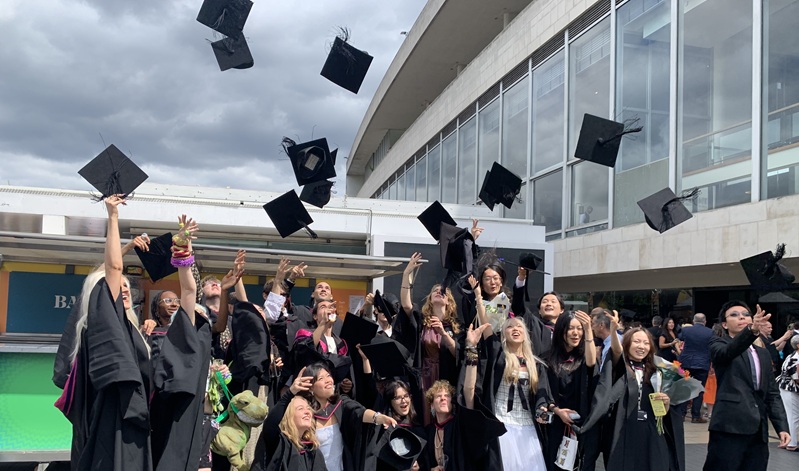
It’s difficult to ignore the paradox. Here we have highly mobile international students rubbing shoulders with others who have directly experienced the effects of climate change. The disconnect is particularly striking when observed in our relatively small international student community, but it highlights a global question. Why do we carry on producing large carbon emissions when we know these are damaging the lives of others?
But hang on, maybe the flying emissions from our students are not that large. To get gauge the issue more accurately, we asked 1700 students across 4 departments at our university about their flying. We found emissions from student flying were almost five times the university’s other emissions combined. Most of this derived from the travel of our international students. The average international student’s flying was equivalent to twice the heating and energy bill of an average UK household. A third was arriving and leaving either side of the summer vacation, but 42% was trips home during the year. Around a quarter was flying to Europe for tourism (which international students do as regularly as our domestic students). Using a published mortality conversion factor, we estimated just the flights taken by all students (domestic and international) at our own university in one academic year, will cause more than 27 excess deaths globally this century.
Unsurprisingly, this is a sensitive issue for universities. As James Ryle, a sustainability manager at the university explained “Historically, it’s been a difficult subject – perhaps because universities are in a difficult position. In the UK, in England in particular, the funding model for universities is very dependent on student fee income. And that from international students is obviously an increasingly important part of the university’s income. It’s a business model.”

We also discovered it was a sensitive issue for students. They can feel passionate about their right to fly home and reconnect with their families, friends and culture. Four focus groups across three UK universities were held to find out more about student motivations to fly. Students in these groups often linked flying to their own well-being. As one international student said, “a lot of Chinese feel too lonely to stay at Christmas. They don’t celebrate Christmas, then they go home a second time for Chinese New Year (end of January to mid-February) because that’s too important to miss.” And, some international students can often face expectations from their families to return home.
Both James and the students also pointed to the government, suggesting national policies were needed that might diminish emissions, whether through reduced financial need for international recruitment or incentivising surface travel more effectively.
And so here we have many parties with something to lose by upsetting the apple cart of student international mobility. Yet everyone will lose if we don’t act on climate. It’s almost as if we’re all waiting for someone else to do something. And it’s not just flying, of course – this feels like a microcosm of the ecological challenge facing humanity: Why aren’t we doing more – why are we just watching disaster unfold?
Some point to the “bystander effect” to explain our inertia in the face of ecological disaster. In 1964, the New York Times reported on the death of a 28-year old local bartender using the headline “Thirty-Eight Who Saw Murder Didn’t Call the Police”. It sparked outrage amongst readers – seeing tragedy develop, how could people just stand by? Social psychologists Latané and Darley explained the bystander effect in terms of a diffusion of responsibility: because each person saw others witnessing the same event, they assumed someone else would take responsibility and call the police – so did nothing to stop the situation themselves.
Moving onto 2014, researchers in the Netherlands were able to show that as the number of people witnessing an emergency increased, so brain activity associated with preparing to take action decreased. In other words, in an emergency, our brain basically stands down if others are watching the emergency with us.
Why do our brains do this? It may be a self-serving bias to let others take the risk. Or, in evolutionary terms, the best outcome of a situation may depend on only the fittest individual stepping up with others contributing more cautiously or not at all, so it makes sense for us to generally hang back. But in 2020, scientists in Taiwan found evidence for an even simpler explanation. They asked individuals to categorise actions as moral or immoral, and noticed that differences in brain activity between individuals reduced in the presence of someone else. In other words, when our brains process what we should do, the presence of others drives us towards social conformity. We just tend to do what others do. So, if no-one else is doing anything yet, I won’t do anything yet either. And that can lead to nobody doing anything – until it’s too late.
But this explanation of the bystander effect also give hope – because when we notice others starting to talk and take action, our idea of what the social norms are (the one we’re trying to conform to) can be changed – as we saw in Episode 4. That means, once a few people start talking and acting, the bystander effect can give way to a domino effect.
Our students suggested one solution would be to build a stronger sense of student community during breaks – especially Xmas – which might encourage some to stay in the UK. It’s also been shown that the bystander effect can also be broken down simply by priming – by activating the pro-social brain networks that help us think about others. These others might include people like Patty and her family – who we heard about at the start of this episode – people who are already feeling the destructive impact of carbon emissions. So, we’re planning a sort of “multilingual karaoke session” with a smattering of environmental messaging. Such an event might lead to a few students not flying home over Xmas, but might also help start that domino effect by changing perception of social norms.
I’ll try to include an update in 2026 about how our eco-karaoke event went!