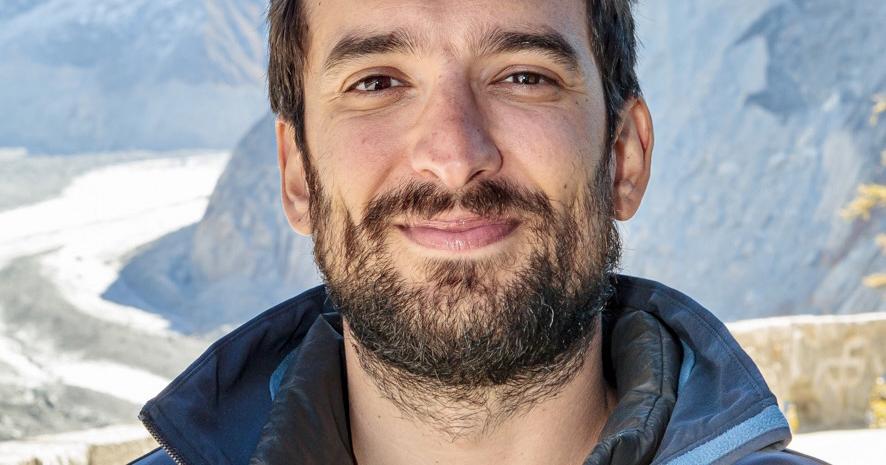
My experience of the Rhone Glacier got me thinking more about “last chance tourism”. Is it an indulgence or could it play a role in helping people become more attuned to environmental issues? So I knocked on the door of someone who has been seriously studying it. Dr Emmanuel Salim is a geographer working in the Universities of Toulouse and Lausanne. Emmanuel has undertaken some interesting research in this area. In 2021, he found half or more visitors to the European Alps were ‘climate visitors’ or ‘last chance’ tourists. Although Emmanuel wanted to emphasise that the motivations are complex, and he was able to unpack them further. He told me “there are these four dimensions of motivation that were related to the urgency, the idea to come to observe the changes, the idea of understanding and the idea of witnessing the place.”
Some of these ‘last chance’ motivations – at least the idea of wanting to understand – feel potentially positive. But what I really wanted to know was whether such tourism could have any positive effect on those who pursue it. My conversations with visitors to the Rhone glacier had left me wondering!

Emmanuel’s more recent research on the pro-environmental intentions of visitors throws some light here:
“It’s clear that the more people are understanding what’s happened in the landscape ….the more they are willing to act. It shows that it’s very important in this place to communicate about the consequences of climate change.”
This certainly makes sense to me. In other words, it’s not enough just to visit these places. Without understanding what’s going on, it’s not likely to have much impact on behaviour and attitudes. But do visitors come away understanding more? Emmanuel gave an example of how easily this can sometimes not happen. In fact, visitors can end up feeling more confused, according to a survey they completed before and after their visit. This survey helped measure how much they knew about climate change and what they were seeing.
“So it was very disappointing because before their visit people said ‘yes, I’m sure I know.’ And after they said ‘oh, but I don’t know, because finally it’s complicated.’”
Emmanuel explained how, in that particular ‘Interpretation Centre’, information about the current retreat of the glacier was being provided. However, so was information about the last glaciation 10,000 years ago. And the Little Ice Age a few hundred years ago – but all with an important element missing. There were no details emphasised how the causes of these three events were different. And there was nothing to explain how we humans have responsibility for what’s happening now.
“So there is a lack of this element in this place that leads people to be confused”, he explained.
In the previous blog entry, I discussed how people tend to disengage from a subject in response to such ambiguity.
So now I’m wondering whether last chance tourism can be mostly a paradox pursued by the confused!
In Churchill, in the Canadian Arctic, tourism adverts make explicit reference to the last chance to see polar bears. The trip involves a flight, so it’s a high carbon intensity trip. Strangely, perhaps, research shows these “last chance” tourists perceive climate change to be negatively impacting polar bears but don’t necessarily understand how they themselves are contributing to emissions or what they could about it, at least in terms of offsetting. On top of that, research on glacier tourism suggests a second paradox in that the more climate aware you are, the more likely it is that you’ll engage in last chance tourism.
Emmanuel beliefs that some sort of “holiday effect” may be at play here:
“There are plenty of studies that show that people who are very environmentally active, when they go on vacations, they forget. ‘okay, we are on vacation this summer. We are really interested in the environment. We heard about polar bear, we want to see them. So, okay, we are doing our best all day, all year long, and so for our vacation, we will do what we want.’ ”
In a world where last chance tourism may increase, I wondered what could make it work more for the environment?
“I think it’s interesting to see that people also want to know and also want to understand. So my idea is ……to try to give people who are visiting the place the key to act when they are going home. For that, we have a concept developed by a friend geographer called Rémy Knafou…..and its called reflexive tourism.”
In reflexive tourism, visitors get the information and resources to reflect and take appropriate action. I saw no indicators at the Rhone Glacier about what I could do, as an individual, about climate change. Nothing even about my emissions, or what I could to address them.

“We provide this information so when you come home, you know better about what you can maybe do as an individual and maybe also as a citizen in the politic system in general. Because one limit to that will be to say, okay, but it’s not only about individuals to take actions. It’s also a political problem.”
Coincidentally, I was reminded of the politics just as i was returning from the Glacier. I encountered a flash protest outside the parliament (the Bundesplatz) in Bern. It reminded me of the importance of political action around this issue. It was about the need to reduce trucks on alpine roads and use freight trains instead.

In the end, the value of last chance tourism to change minds may depend on how it’s done. But Emmanuel also considers that last chance tourism may eventually morph into something with a stronger flavour. He foresees the rise of “dark tourism” – with more commemorations and funerals to mark the passing of the glaciers. This is a bit more of a provocative angle perhaps. And it may also serve a positive political purpose.
“In 2023 in Switzerland, there is this initiative for the glacier”, Emmanuel explains. ”The Glacier Initiative to try to bring the Paris Agreement objective into the climate law of Switzerland. And by organizing hiking around glaciers, they finally do it. And so we see, in a way, that glaciers are becoming places where people commemorate and remember past glaciers and that the glacier also becomes a political flag to protect the environment in a political way.”
I find this fascinating because recent research has confirmed that walking in nature improves our affect. It doesn’t necessarily improve our basic cognitive function – but our feelings and emotions become more positive. So, to me this makes perfect sense, to have political meetings at glaciers and in nature and involve hiking. That really should encourage self-transcendence. In other words, help people get over themselves and their short-term concerns. That may help encourage decision-making that, in the longer term, will benefit the environment and all of us.